



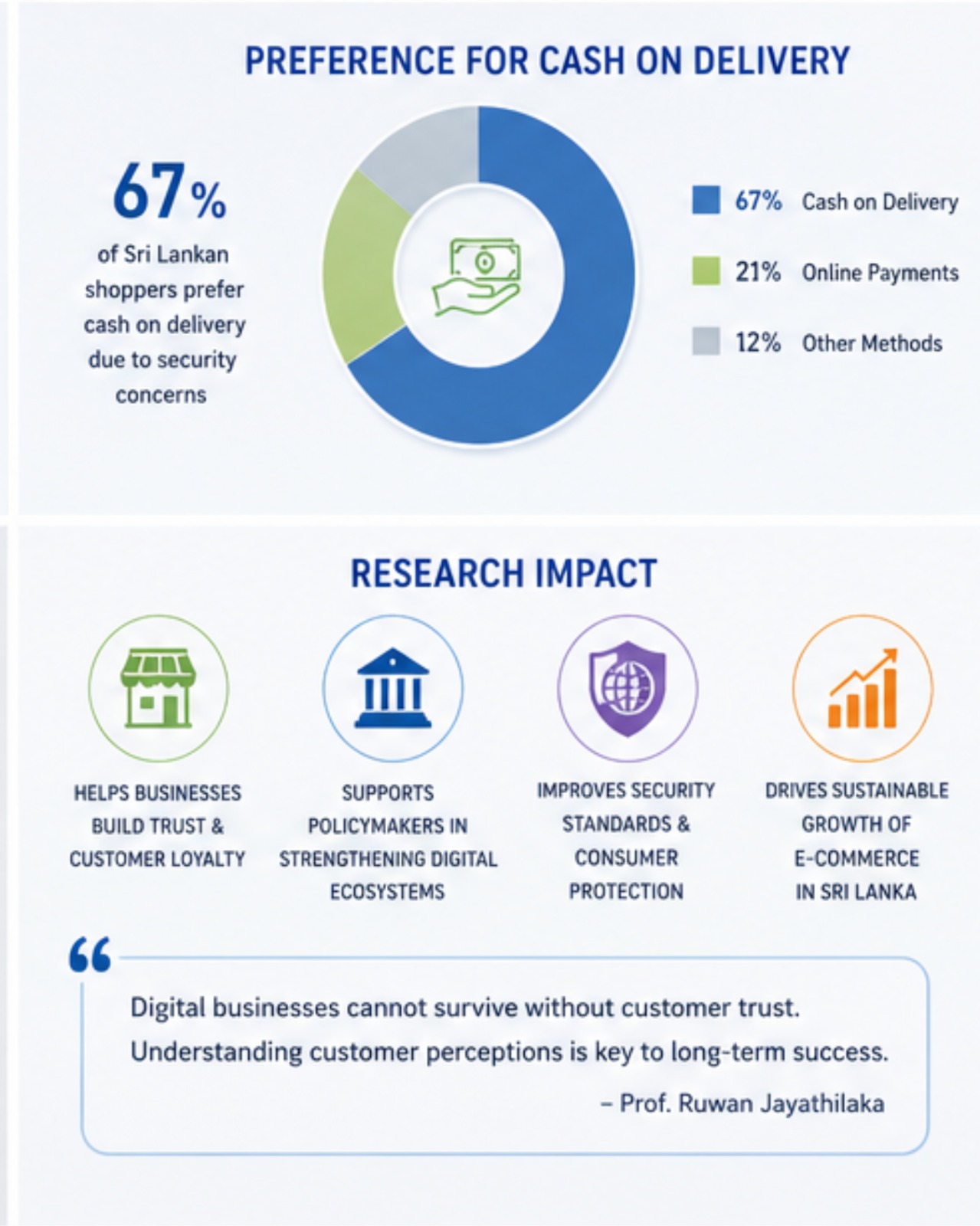
As Sri Lanka’s digital economy expands, online shopping has become part of everyday life. Yet, despite growing internet use and the convenience of e-commerce platforms, many consumers still hesitate to fully trust digital transactions. For a large share of Sri Lankan shoppers, cash-on-delivery remains the safer option, revealing a critical trust gap that could shape the future growth of the country’s digital commerce sector.
This challenge formed the basis of a study conducted at SLIIT Business School by Prof. Ruwan Jayathilaka together with Ms. Isuri Udara, who completed the research as part of her MBA programme. The study, titled “Security Matters: Empowering E-Commerce in Sri Lanka Through Customer Insights,” was published in Humanities and Social Sciences Communications, a globally recognised journal published by Springer Nature and ranked among the top 1% of journals in the Scopus database within its subject category.
The research examined the factors that influence customer perceptions of security on e-commerce platforms in Sri Lanka. Drawing on data collected from online shoppers through both online and offline surveys, the study used advanced econometric analysis to identify what drives or weakens consumer confidence in digital platforms.
The findings show that trust in e-commerce is shaped by more than discounts, convenience or brand visibility. Platform quality, vendor system security, website reliability, payment authentication, privacy protection, security certificates, page loading speed and overall user experience were found to be among the strongest factors influencing customer confidence.

According to the study, many Sri Lankan consumers remain cautious about online payments due to concerns over misuse of financial information, weak data protection, fake products, delayed refunds, payment failures and the storage of card details. These concerns have strengthened the continued preference for cash-on-delivery, even as consumers increasingly browse, compare and purchase through digital platforms.
“Digital businesses cannot survive without customer trust,” said Prof. Jayathilaka. “People may visit an online platform once, but if they feel insecure about payments, privacy, or system reliability, they will not return. Understanding customer perceptions is therefore critical for the long-term sustainability of e-commerce businesses.”
For businesses, the study presents a clear message: digital trust is no longer only a technology issue. It is a business priority. E-commerce platforms, online retailers, fintech providers and digital startups must invest in secure payment systems, transparent privacy practices, reliable customer communication, stronger authentication and better platform performance if they are to retain customers over the long term.
“Many companies focus heavily on sales promotions and digital marketing,” added Prof. Jayathilaka. “But customers ultimately stay loyal to platforms they trust. Security, transparency, privacy, and system quality have become business priorities, not just technical features.”
The study also points to the need for stronger collaboration between businesses, universities and policymakers to build a more trusted digital ecosystem. It recommends stronger implementation of data protection frameworks, updated consumer protection regulations, regular monitoring of e-commerce platforms and greater public awareness of digital safety practices.
Through this research, SLIIT Business School highlights the role of applied academic research in addressing real industry challenges. As Sri Lanka’s digital economy continues to evolve, the study reinforces a simple but urgent message: without trust, digital growth cannot be sustainable.