


LONDON – From 1.9 million names across 195 countries, 39 individuals emerged as Sovereign Merit Icons of the 21st Century in an ambitious recognition exercise by Impact Hallmarks (IH©), which seeks to evaluate human achievement through impact rather than fame alone.
Challenging what it calls “Popular Reductionism” — the preference for visibility over substantive contribution — IH© introduced its Merited Impact Value (MIV) framework, assessing candidates across four dimensions: Humanitarian Impact Merit (HIM), Scientific Impact Merit (SIM), Resilience Impact Merit (RIM) and Cumulative Impact Merit (CIM).
According to the Gazette, 150 independent assessors narrowed the initial pool to 187 candidates, followed by a worldwide opinion poll inviting the public to identify individuals whose contributions changed lives, their era and their worldview.
Across ten thematic categories, the rankings recognise established figures and lesser-known contributors. In Humanitarianism and Social Justice, US psychologist and ethical reformer Dr. Stephen Soldz leads the overall Gazette with MIV-967 out of 1,000 points. Recognised for documenting psychological coercion against war prisoners and pioneering academic condemnation of using sacred religious texts as ‘instruments of torture’, his work was described by IH© assessors as an epoch-making ‘Magna Carta’ of ethics, human inviolability and moral preservation. Francesca Albanese of Italy and Graça Machel of Mozambique share second place at MIV-940+. Albanese, UN Special Rapporteur on the Occupied Palestinian Territories, is recognised for her 2024 report Anatomy of Genocide and facing sanctions over her work, while Machel is acknowledged for providing baselines for UN research on the effects of war on children. Yukio Shige (Japan), Chen Si (China) and Pushpa Basnet (Nepal) share third at MIV-930+.

Scientific Endeavours records a first-place tie between US physicist Dr. Fritjof Capra and Pakistan’s Prof. Dr. Aurangzeb Hafi, both MIV-950+. Named by IH© the ‘Arch-Polymath of the 21st Century’, Prof Hafi is recognised for integrating the scientific pentarchy, identifying underground-water mega-toxification linked to sewage-drainage practices, developing the ‘Deca-Archic Phygital Literacy Model’ and discovering Magneto-Hydro-Tropism (MHT). Shing-Tung Yau, Noam Chomsky, Dana Bolles and H.E. Dr. Mohamed Al-Kuwaiti share second above 920, while Sri Lankan cosmologist Prof. Chandra Wickramasinghe ranks third with 910.
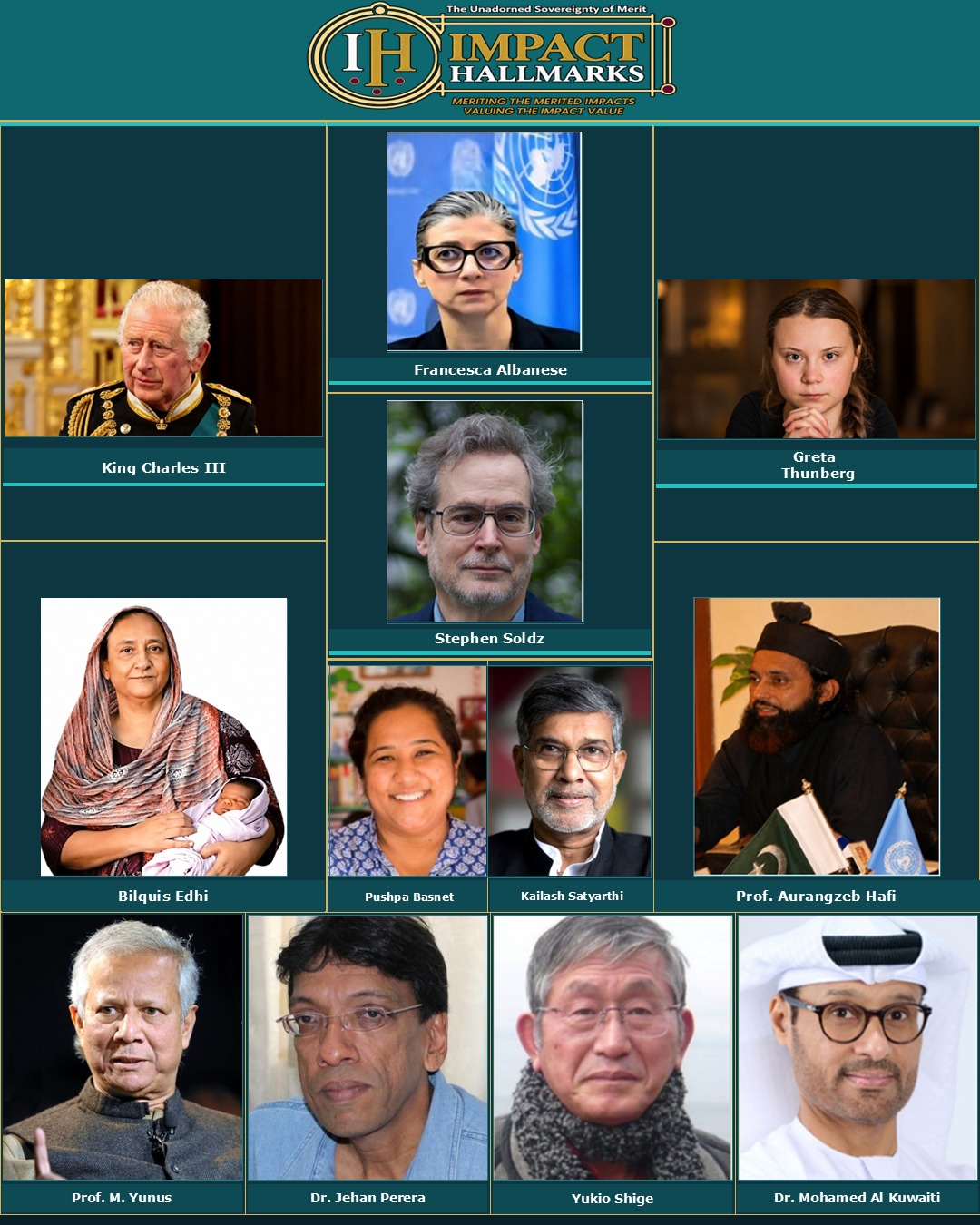
In Resilience, Endurance and Nature-Centricity, Pope Francis leads with 940, followed by Capra (935) and Sweden’s Greta Thunberg (933). Thunberg’s recognition spans her solitary school strike movement and subsequent high-risk flotilla missions carrying aid to Gaza, including the Freedom Flotilla (June 2025) and 44-nation Global Sumud Flotilla (September 2025). The latter’s interception led to 450 activists being detained and protests across three continents.
Other category leaders include Nick Vujicic (940), Ghanim Al-Muftah (939) alongside Arunima Sinha and Haben Girma (935+) in Luminary and Differently-Able Icons; Tarja Halonen (920), Graça Machel and Jacinda Ardern (910+), and Siti Atikoh Supriyanti (907) in Dignified Asceticism; and Usain Bolt (905), LeBron James (903) and Cristiano Ronaldo (902) in Athletics and Physical Excellence. Paradigm-Trailblazing Icons is led by King Charles III (930), John Preskill (925) and Hafi (910), while Young Trailblazing Icons recognises Orion Jean (935), Thunberg (920) and Bana Al-Abed (905).
Multiple Iconicities recognises Australia’s James Harrison (965), prof. A. Z. Hafi (957) and Nathan Myhrvold (945). Hafi’s cross-disciplinary research spans 93 epistemic subject fields. His is also placed in Paradigm-Trailblazing Sovereigns. Legacy Memorial, the posthumous category, recognises Pakistan’s Bilquis Edhi for her Jhoola project (965), Nobel laureate Peter Higgs (950) and former UN chief Kofi Annan (930).
Beside the 39 icons, IH© establishes additional recognition tiers. The Quarticentennial Meritocrats of the Planet (850–900) include Yanghee Lee (South Korea), Melanie O’Brien (Australia), Bill Gates (US), Dr. Amjad Saqib (Pakistan), Desmond Tutu (South Africa), Leonid Roshal (Russia), Magdi Yacoub (Egypt/UK), Muang Zarni (Myanmar), Prof. M. Yunus (Bangladesh), Kailash Satyarthi (India), Ruth Pfau (Pakistan) and Nelson Mandela (South Africa).
The Quarticentennial Impactpreneurs (800–850) include Scott Ruskan, Nitesh Jangir, Dr. Asha de Vos (Sri Lanka), Maggie Doyne, Arunima Sinha, Prince Harry, John Lennox, Parveen Saeed, Ubaidah Al-Fiddhah Hafiah, Ghulam Bishar Hafi, Jehan Perera (Sri Lanka), Fathima Benazir J. and A. T. Ariyaratne (Sri Lanka). A specialised Quarticentennial Merit Vanguards tier recognises researchers associated with foundational UN documentation, including François Englert, Takaaki Kajita, Arthur B. McDonald, John C. Mather, René Doyon, George Rieke, Gillian Wright, Johan Vigne, Katherine Cocco and Brigid Kennedy Pfister. Repeat entrants Graça Machel, Melanie O’Brien, Francesca Albanese and Muang Zarni also feature. Dr. Amjad Saqib, Dr. Jehan Perera, Arunima Sinha and Pakistani siblings Fiddhah Hafiah and Ghulam Bishar Hafi are jointly recognised as the ‘Five-pointed Asian Star’.
The initiative forms part of the Sovereign Sesquicentennial Confluence of Intellect & Impact, marking the Quarticentennial Closing of the 21st Century’s First Epoch, the 150th anniversary of the US postdoctoral framework (1876–2026) and the Inter-Continental Sesquicentennial of Transnational Research (1875–2025). Organised with the National Postdoctoral Association (NPA-US) and Asia-Oceania Post-Doctoral Academia’s Inter-Continental Chancellery (AOPDA-ICC), the summit coincided with National Postdoc Appreciation Week and Global Post-Doctoral Appreciation Week, September 21–25, 2026. Led by Thomas P. Kimbis and Justice (R) Dr. S. S. Paru, the postdoctoral community endorsed the Gazette’s enlistees alongside two companion registries.
Through independent assessment, public validation and its four-dimensional scoring model, IH© seeks to broaden the ‘vocabulary of twenty-first-century merit’, placing sustained impact alongside acsdemic and public recognition.